Exploring the Périgord Vert by camping car: Part 2 – Brantôme.
A short hop from Bourdeilles is the town of Brantôme, where we stayed at the local aire for two nights. It was perfectly situated, just a pleasant stroll from the town centre.
Often referred to as the Venice of the Dordogne, Brantôme is wrapped in the gentle embrace of the River Dronne. With the help of Benedictine monks more than a century ago, the river was cleverly diverted to encircle a part of the town, forming an island at its heart.
The following morning, we wandered into town along the Dronne, passing the picturesque Le Moulin de l’Abbaye restaurant with its charming water wheel. Crossing the bridge, we paused at the weir to watch fish gliding in the crystal-clear water.
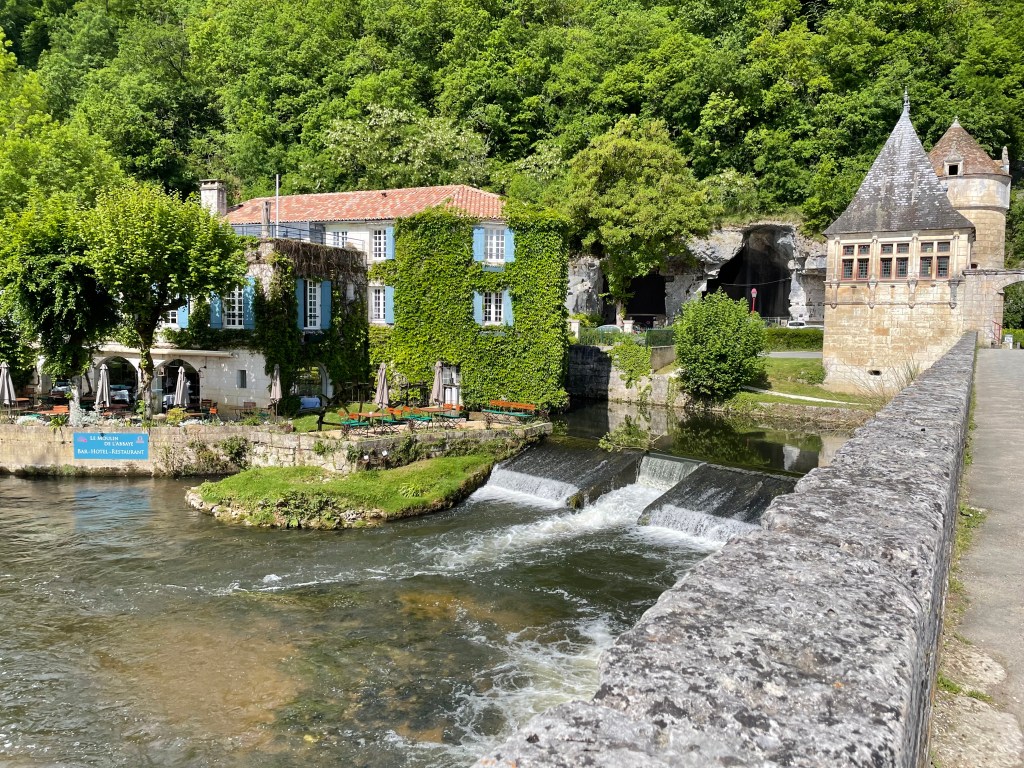
Brantôme’s Benedictine abbey has roots stretching back to the 8th century, when monks lived in the troglodyte dwellings carved into the cliffs. Over the centuries, the abbey suffered multiple destructions, most notably during the Hundred Years’ War between the French and the English. In 1557, Pierre de Bourdeilles, better known as Brantôme, was appointed Abbot. A writer and poet, he was rumoured to have had a romantic connection with Mary Queen of Scots. By the time of his death, the abbey was one of the most prosperous in the Aquitaine region. However, following the French Revolution, it was abandoned.
Today, the abbey remains in remarkably good condition. As its bells rang out, summoning the faithful to prayer, we saw a well-dressed young couple sprint past with a baby in arms, clearly late for church.
Behind the abbey, nestled against the limestone cliffs, lie the ancient troglodyte dwellings: a series of caves expanded over time into cellars, homes, quarries, and communal underground spaces, many of which are difficult to date precisely.
An Enigma in Stone
One cave, known as the Last Judgement Cave, features two monumental carvings etched into the rockface. To the right, a vivid Crucifixion scene; beside it, a mysterious second carving that defies clear interpretation. Over the years, scholars have proposed numerous theories: is it a pagan deity? A terrifying vision of the Last Judgement? Whatever it may represent, it leaves a lasting impression.
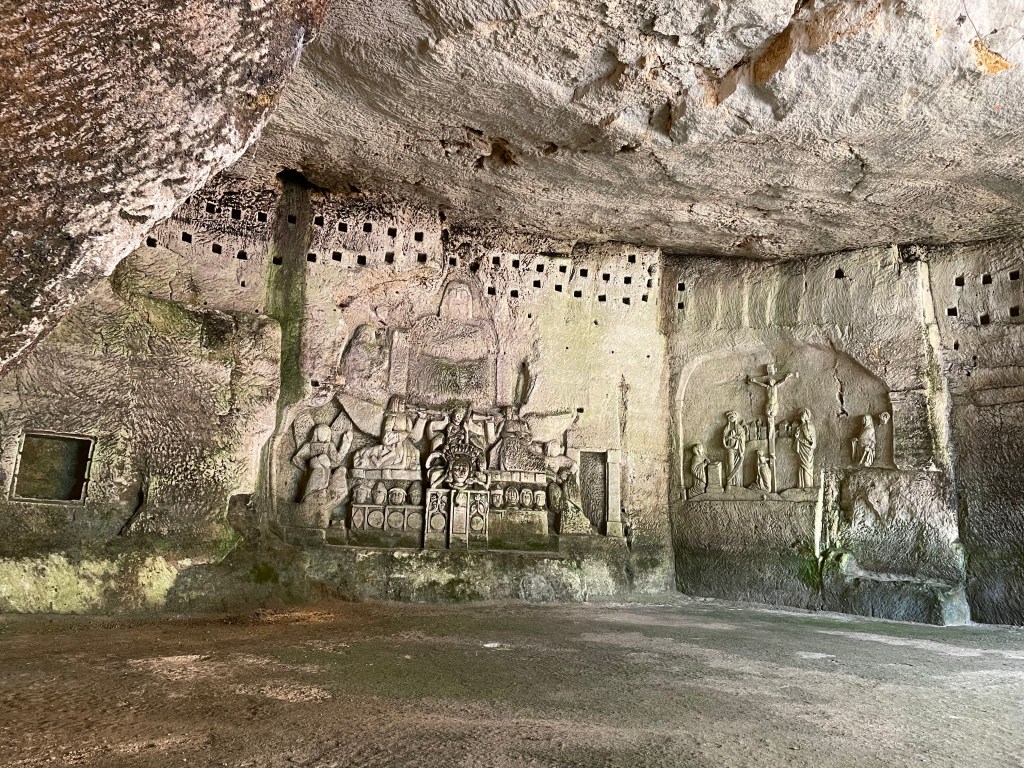
Also within the cave is a pigeon house, a vital resource for the monks. Pigeons provided meat, and their droppings, once a valuable fertilizer, were part of a flourishing trade.
The St. Sicaire fountain, pouring from deep within the caves, is said to possess miraculous properties and has long drawn pilgrims. Nearby, a natural spring likely contributed to the monks’ original decision to build their abbey here.
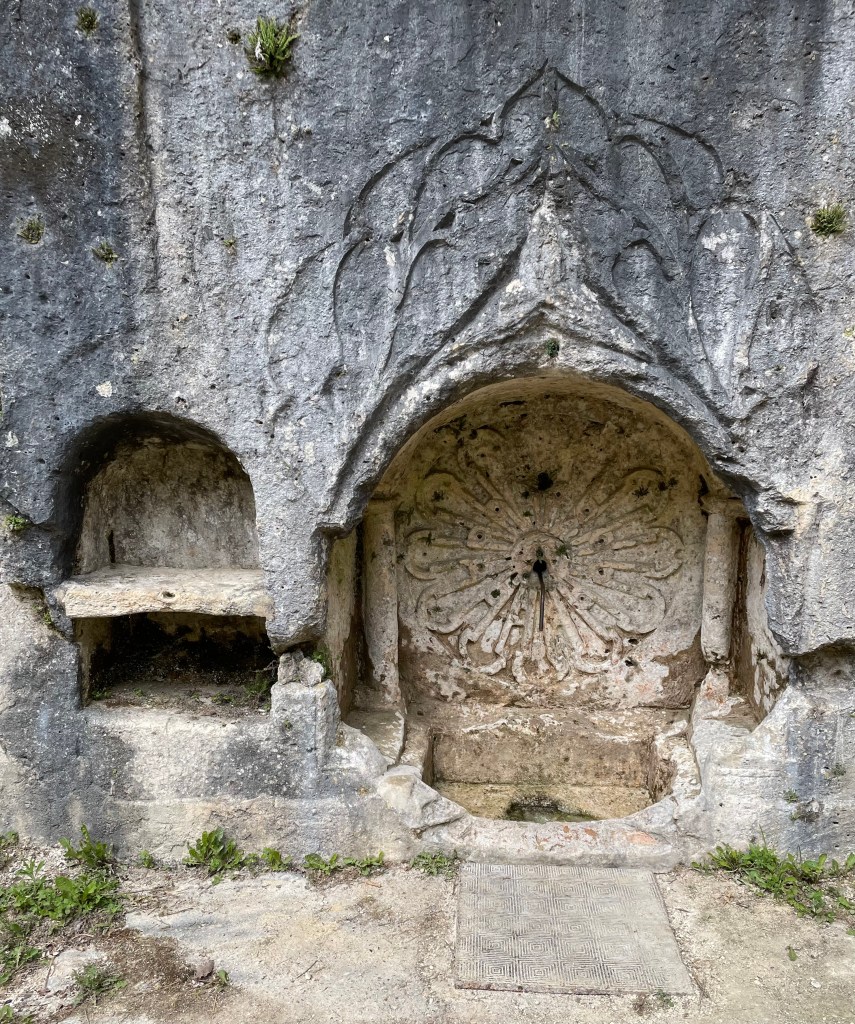
Take your time if you visit, there are many well-done information panels, and the entire site is truly extraordinary.
We had lunch in the sunshine by the water’s edge, watching fish dart beneath the surface and ducks bob along, while a few young adventurers drifted past in canoes. We loved Brantôme, and later that afternoon, we headed back to our camping to plan the next stage of our Dordogne road trip.
If you would like to read more about other places in the Dordogne, then you may be interested in my book, My Dordogne Life. Available on Amazon, links below.
 Janice Croizet Author
Leave a comment